Unique 9-kilometer-long European village preserves medieval layout
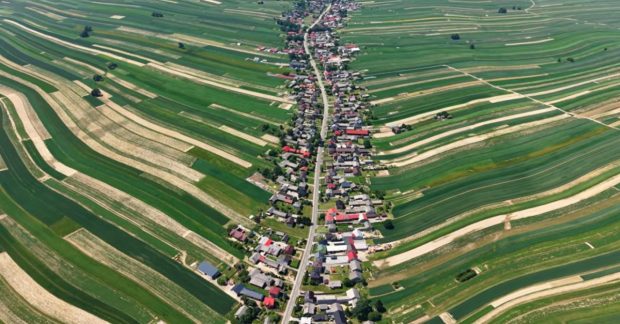
The Polish village of Suloszowa has stretched along a single road for 700 years, creating a unique architectural and landscape phenomenon.
 👥Society
Photo: UNIAN
Key points
- Suloszowa in Poland extends along a single road for 9 kilometers.
- The medieval settlement structure has survived into the 21st century.
- Unique aerial views of the farmlands have turned the village into a global tourist attraction.
Across Europe, there are settlements whose layouts amaze with their originality and history. One striking example is the Polish village of Suloszowa, located about thirty kilometers from Krakow. For roughly seven centuries, thousands of people have lived here along a single road, with wide agricultural fields stretching directly behind their homes.
A medieval architectural experiment
This settlement represents a fascinating example of a historical rural planning format known as a linear village. Residential houses, shops, and public facilities are arranged on both sides of a winding road stretching nearly nine kilometers. Directly behind the homesteads lie narrow strips of farmland, creating a stunning mosaic of green and golden hues from a bird's-eye view.
As local residents and authorities point out, this layout once solved logistical challenges efficiently, providing owners with direct access to both the main transport route and fertile land. Despite wars and historical changes, the original spatial arrangement has survived to the present day.
«Here, almost everyone knows each other,» shares local shop owner Edita, highlighting strong community ties and traditional harvest celebrations.
Today, Suloszowa's unique landscape attracts travelers worldwide thanks to striking aerial photographs. Beyond its unusual layout, the region is known for its natural beauty and historical landmarks, including the 14th-century Pieskowa Skala Castle and the rock formations of Ojcow National Park.
Source UNIAN — unian.ua/tourism/news/suloshova-u-polshchi-chomu-selo-na-9-km-pobud… ↗
Read next
 🎓Education
Ancient bacteria from permafrost revived after 40,000 years: research results
Scientists from the University of Colorado have activated microorganisms that have been frozen for millennia, discovering their ability to multiply rapidly upon thawing.
 💡Tech
Chinese underwater drone for search operations goes on sale
A compact underwater robot capable of operating at depths of up to 100 meters has hit the market. The device is designed for hull inspections and underwater search tasks.
 🎓Education
Ukrainian gardener grows a giant 350-kilogram pumpkin
A resident of the Cherkasy region, Oleksiy Buryachenko, grew a giant pumpkin on his plot, which became the largest in Ukraine, and distributed it for free to the local co…
 🏛️Politics
US Director of National Intelligence: Putin is not America's friend
US Director of National Intelligence Jay Clayton stated that despite diplomatic protocols, Russia cannot be considered a friend of the US, particularly regarding the war …
 🚌Transport
Aftermath of the attack in the Kyiv region: death toll in Dymer rises to eight
Rescuers have recovered the body of the eighth victim of the Russian strike on Dymer. Search and rescue operations at the site of the destroyed building are ongoing.
 🧠AI Analysis
ISW Analysis: Why humanitarian initiatives on the front line have different geographical perspectives
Analysts from the Institute for the Study of War explained why Russia's proposal for evacuation from Kostiantynivka is unrealistic compared to Ukraine's initiative for th…