Footprints of Giants: Scientists Rediscover Unique Dinosaur Site in Mongolia After 70 Years
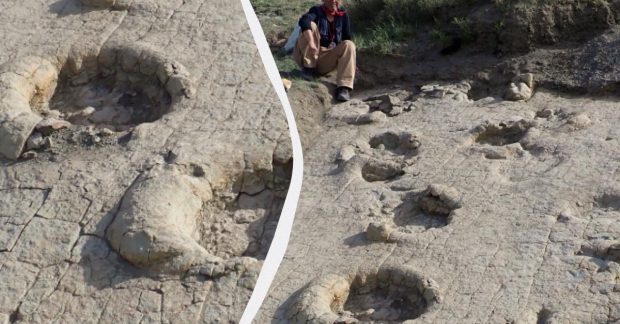
Researchers have successfully relocated a significant paleontological site in Northern Mongolia, identifying 31 fossilized dinosaur tracks dating back 120 million years.
 🎭Culture & Sport
Photo: UNIAN
Key points
- A dinosaur track site lost for 70 years has been rediscovered in Mongolia.
- 31 footprints were identified, including 15-meter-long sauropod paths.
- The discovery proves large predators up to 8.8 meters long lived in the region.
Paleontologists have rediscovered a unique site in northern Mongolia featuring fossilized dinosaur footprints, the exact location of which had remained a mystery for the past seven decades. Researchers identified 31 imprints left by giant creatures approximately 120 million years ago. This discovery not only returns a lost object to science but also provides new data on the distribution of large dinosaurs during the Early Cretaceous period, which was previously considered unlikely for this region due to its harsh climate.
About 120 million years ago, this area was a lakeside environment where wet periods alternated with drier ones. As water levels receded, patches of mud and sand were exposed, providing a surface for dinosaurs to leave their marks. Over time, these footprints were preserved in sedimentary rocks, surviving to the present day as clear stone casts.
Paths of Giant Herbivores and Predators
Among the most impressive finds are two tracks of sauropod footprints exceeding 15 meters in length. These massive herbivores likely followed the same routes to expend less effort moving their enormous bodies. Scientists compare this behavior to modern elephants, which use established paths to navigate difficult terrain. The shape of the sauropod prints reveals a combination of features characteristic of primitive dinosaurs and more advanced titanosauriforms.
In addition to the peaceful giants, the site recorded the presence of large theropods—bipedal carnivores. The largest footprint found measures about 57 centimeters in length. According to scientific estimates, the body length of the predators that left these tracks ranged from 7.4 to 8.8 meters. This proves that the ecosystem of northern Mongolia was capable of supporting ultra-large predators, despite potential seasonal temperature fluctuations.
Previously, it was assumed that harsh winters in the interior of Asia might have limited the spread of very large dinosaurs. However, the discovery of 31 footprints challenges these assumptions. While it is impossible to determine exact species from tracks alone, their presence indicates a rich biodiversity in the region's ancient past.
Fossilized tracks are exceptionally valuable for studying animal behavior, as skeletons do not always provide a complete picture of their lifestyle. Trackways allow researchers to estimate movement speed, interaction with the environment, and even social structures. Scientists hope that nearby sandy layers may contain other remains, such as teeth or bones, awaiting future discovery.
Source UNIAN — unian.ua/science/slidi-dinozavriv-u-mongoliji-znaydeno-31-vidbitok-… ↗
Read next
 🇺🇦Ukraine
Poland Scrambles Jets During Russian Strike on Ukraine: Drone Enters NATO Airspace
During a massive Russian attack on Ukraine, a drone flew 70 km into Polish territory, prompting the Polish military to activate air defense protocols.
 🛡️Security
Ukraine at UN: Demands for Troop Withdrawal Are Not a Path to Peace
Ukraine’s Deputy Permanent Representative to the UN Volodymyr Pavlichenko stated that Russian demands for withdrawal from Donbas are a prelude to further aggression.
 👥Society
Experts reveal details of the successful operation on the Crimean Bridge
Aviation expert Kostiantyn Kryvolap discussed the use of secret Ukrainian developments and advanced communication technologies during the attack on the Kerch Bridge.
 👥Society
Heating issues in cities: actress Antonina Khizhniak reports on the situation in Ukrainka
Well-known actress Antonina Khizhniak shared information about the critical heating situation in the city of Ukrainka, where her grandmother lives.
 🛡️Security
Germany plans to allocate €11.6 billion in military support for Ukraine in 2027
The German government continues to scale up its military assistance, earmarking over €11 billion for Ukraine in the 2027 budget.
 👥Society
King Charles III and Idris Elba feature in new charity documentary
The British monarch and the actor star in a Netflix documentary highlighting the impact of The King's Trust.